
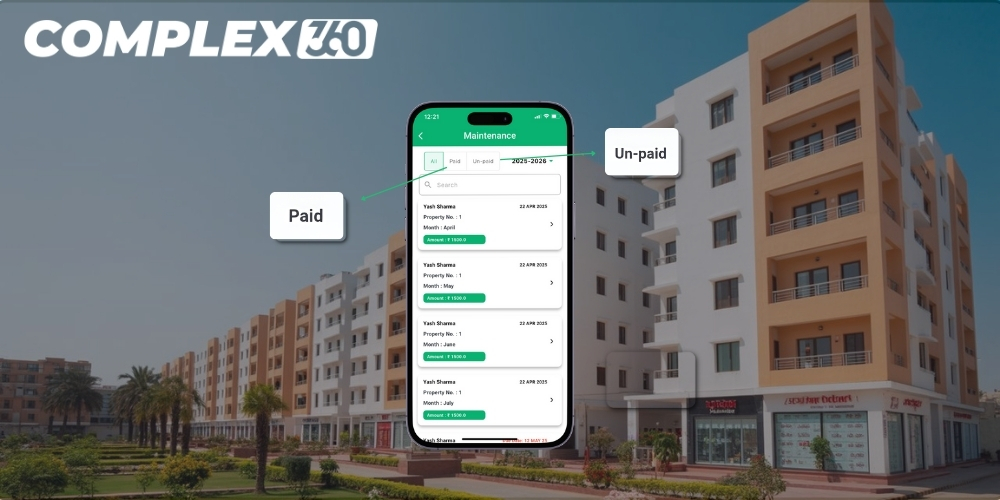
Commercial Complex Maintenance Management App
Maintenance usually becomes stressful in commercial complexes not because people don’t want to pay, but because no one is sure what is actually unpaid and what has already been paid. Complex360’s Maintenance Management module focuses on that gap, showing the right unpaid amount against every office, shop, and commercial unit, updating status when payments are done, and giving management teams a clear picture of collections without getting stuck in spreadsheets.
This module is ideal for business parks and commercial campuses where different types of units share the same infrastructure and the management has already decided how much each category should contribute. Instead of chasing those decisions in separate files, Complex360 turns them into clear, trackable maintenance records that everyone can see and understand.
Turn committee decisions into clear maintenance dues
In every commercial complex, maintenance rules come from the owners’ association, facility team, or AGM. Those rules can be simple or complex, but they are already agreed upon inside the community; the challenge starts when those decisions are moved into multiple Excel files, manual registers, and message threads, where numbers get updated in one place and not another and people quickly stop trusting what they see.
In Complex360, the same unit details that are used in your Property Management setup are used for maintenance. Once the committee sets the maintenance amount or pattern for different categories of commercial units, the app uses that as the reference going forward, so when a new month or cycle starts, the system knows exactly how much each office or shop is expected to pay without anyone having to build formulas again and again.
Because the logic is saved inside the system, you are not rebuilding maintenance from scratch every time. You work on top of a consistent base where each unit’s expected maintenance is always calculated in the same way, ready to show or bill in a few clicks.
Show every unit exactly what is unpaid
From a business occupant’s point of view, maintenance should answer a simple question: “What do I need to pay right now?” Complex360 makes that answer obvious. When an office or shop user opens the app, they see a clear “My Dues” view that belongs only to their unit or units, showing what is currently unpaid, what has been paid earlier, and whether anything is overdue.
There is no need to wait for printed slips or call the office to confirm balances, because if the facility team changes rates for future periods, those changes are applied centrally and reflected the next time maintenance is generated. Occupants still see one clean number for their current dues, without having to worry about how the calculation is done in the background.
This simple transparency reduces a lot of small, repetitive questions. People can check their own status in a few seconds and decide when and how they will clear their bills, while the management team always works with accurate, up‑to‑date figures.
See Maintenance for Every Unit
Keep a clear view of unpaid and paid maintenance for every office, shop, and commercial unit in your complex in one place.
Simple ‘My Dues’ View for Users
Let owners and business tenants open the app and instantly see what is unpaid for their own commercial units.
Always‑Updated Payment Status
Change a unit’s status from unpaid to paid as soon as payments are recorded, so maintenance information always stays accurate.
Let payments automatically update status
Maintenance work does not end with telling businesses how much they need to pay; the other half is keeping track of who has actually paid. Complex360 helps by tying maintenance status to the same unit records that are used everywhere else in the system, so when a payment is recorded for an office, shop, or other commercial unit, that unit’s maintenance status moves from unpaid to paid.
Over time, each unit builds a small payment history inside the app, showing which periods were paid on time, which ones were delayed, and what is still open. This history is useful for both the occupant and the management team, because occupants can see that their payments have been correctly recorded while committees can see patterns across towers and wings without opening separate files.
If a due date passes and maintenance is still unpaid, the system can trigger reminders so that occupants are gently nudged to take action. This turns follow‑up into a simple, structured task instead of a series of manual calls and visits.
Give committees a live maintenance picture of the whole complex
For committee members and facility teams in commercial complexes, the main need is not just bill values but an overall picture of collections: which towers are doing well, which wings need more attention, and how different types of units are behaving. Complex360 provides this through clear “All / Paid / Unpaid” views that group commercial units based on their status.
In one place, a committee member can see how many units are fully clear, how many have partial or full unpaid amounts, and how this is spread across towers, floors, or blocks, with filters that make it easy to focus on one building, one wing, or one type of unit at a time.
Because this view is always based on the latest data, committees do not need to ask someone to prepare fresh defaulter lists before every meeting. They can open the app, see the real‑time picture, and plan action on top of what is already there.
Manage Your Property With Confidence
Complex360 gives property owners, secretaries, and administrators a complete digital system to manage all units, occupants, and records effortlessly. Everything stays organized, accessible, and up to date.
Handle commercial maintenance without mixing categories
Commercial complexes often include different types of business units that behave very differently, yet they sit inside the same premises. Complex360 keeps all these units in one system while allowing you to apply different maintenance rules to different commercial categories, so you can manage everything together without mixing them up.
A simple way to think about it:
| Aspect | Commercial Offices and Shops |
|---|---|
| How maintenance is decided | Based on fixed or agreed amounts for offices, shops, clinics, warehouses, or by size/category. |
| Who sees the dues | Business owners or office users linked to those commercial units. |
| What the committee sees | A single dashboard where they can filter and see only selected categories of commercial units. |
The benefit is that committees and facility teams do not need to manage multiple separate systems. They can view each commercial category separately when required, and still bring everything together whenever they want a complete picture of the complex.
Make financial‑year and recurring maintenance easier to handle
Many commercial communities think in terms of financial years, even when they generate maintenance monthly. They want to know how much has been raised and collected for a whole year and how much is still unpaid, and Complex360 helps by keeping maintenance organised by periods so you can see dues and payments for specific months, quarters, or full financial years.
The module also supports generating maintenance for a full financial year using patterns defined by the committee, so you can set up how maintenance should behave across the year and then use the system to create the corresponding entries instead of creating each one manually.
When it is time to share figures with a CA or present numbers in a review meeting, the maintenance data is already grouped and ready to be shared, rather than being spread across multiple sheets and files.
Connect maintenance with the rest of your complex data
Maintenance in Complex360 does not exist in isolation; it sits on top of the same unit information that powers your commercial property records and links naturally with other modules. When Property Management is up to date, maintenance inherits those changes automatically, so if ownership changes or a new business tenant is added, that unit’s future maintenance is shown to the right person without extra work.
This reduces mistakes that happen when one list says something and another list says something else, because everyone is working from the same base and maintenance becomes just one more view of accurate complex data rather than a separate, conflicting version of it. You can also align maintenance with complaints, meetings, or other parts of complex operations, so when a committee discusses maintenance in a meeting, all the relevant numbers are already available in one place.
Make maintenance feel fair, not frustrating
At the end of the day, maintenance is a sensitive topic in commercial complexes. People want to feel that what they are being asked to pay is correct, that their payments are recorded properly, and that management is working with accurate information, and Complex360’s Maintenance Management module is designed to support exactly that kind of trust.
For occupants, it means a simple app that always shows the same unpaid amount and history as the office sees, without confusing parallel lists. For committees and facility teams, it means a single, reliable view of collections across all commercial units without having to rebuild reports every month, so maintenance stops feeling like a monthly argument and starts behaving like a regular, predictable part of running a modern commercial complex.
Frequently asked questions
Yes. Complex360 gives each owner or business tenant a “My Dues” screen in the app where they can see their current unpaid maintenance, past payments, and due dates for their commercial units.
Committees can use Complex360’s “All / Paid / Unpaid” views to filter commercial units by status and instantly see which offices or shops are clear and which need follow‑up.
Complex360 shows unpaid and paid maintenance for every commercial unit in one dashboard, so committees and facility teams can quickly see who has cleared their dues and who still has unpaid amounts.
Complex360 is designed specifically for modern commercial complexes and business campuses, helping committees apply their own maintenance rules, track unpaid and paid status, and avoid manual spreadsheets.
Complex360 lets committees define separate maintenance patterns for different categories of commercial units, such as offices, shops, and clinics, then shows unpaid amounts for each category without needing two different systems.
Complex360’s Maintenance Management is linked with its Property Management module, so unit details and occupant changes automatically flow into maintenance records and unpaid dues are always shown against the correct business contact.
With Complex360, committees can generate maintenance for a full financial year based on their approved patterns and then track unpaid and paid amounts period by period for every commercial unit.